Drinking Water

Public Health | Environmental Health

The Skagit Public Health Drinking Water Program works to protect public health by ensuring people have access to safe, reliable drinking water. The program:

  • Helps ensure drinking water comes from safe and appropriate sources.
  • Reviews proposed water sources and locations to protect public health.
  • Applies public health standards and best practices to protect drinking water supplies.
  • Ensures proposed plumbed structures have an adequate water supply as part of the building permit process.

Frequently Asked Questions

When you're proposing development (single-family residence, accessory dwelling unit, commercial building) you will be required to submit a Water System Evaluation application.  

Some development applications are exempt from a Water System Evaluation.  

  1. Repairs of existing buildings that will not increase the use of an existing water supply;
  2. Remodel or replacement of existing, nonresidential buildings when the new work will not increase the use of an existing water supply; and
  3. Remodel or replacement of existing residential buildings that do not:
    1. Increase the number of bedrooms; or
    2. Add more than five hundred (500) square feet of gross floor area.

SCC 12.48.040 (3) “PDS shall not issue any building permit for a structure with plumbing, or land division approvals until the Health Officer has approved the water system.”

The required documentation depends on the water source that serves your parcel. See the Water System Evaluation Application Documentation below.

  1. Visit the Skagit County Property Search page.
  2. Search for your property.
  3. Click PERMITS tab.
    1. Look for Water System Evaluation. It can be shown in three different formats (W92-0000, WA01-0000, or WATER-2025-0000).
    2. Water source may be shown in description.
    3. Information may be accessible with file icons attached, 

      If information is not accessible online, please submit a records request with the W, WA, or WATER number. 

If your water source may be a Public Water System, use the Washington State Department Of Health’s Source Water Assessment Program Mapping Application (SWAP Map).

For assistance using SWAP Map use the “Help” link in the upper right corner of the page.


If your property does not appear to be within a public water system service area, the property may have a different water source that is not a public water system. 

All wells, regardless of if it is drilled, dug, or jetted, should have a well log or drillers report registered with Washington State Department of Ecology (ECY). These reports can be found on ECY’s well search page. You may need to search by previous owner name, Well Tag ID, or address.  

For assistance using the search criteria refer to the “Need Help?” link in the upper right corner of the page.

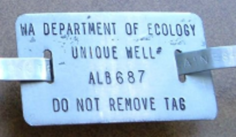
If you know the property has a well but you cannot find a water well report, you may need to contact a well driller to create a new water well report for the existing well if desired and assign a new well tag ID# to the well (see picture below).

Group A Public Water Systems are required to test the water served to you on a regular basis. You can find the test results using Washington State Department of Health's Sentry Internet page. 

Water quality samples should be analyzed by an accredited laboratory. Department of Ecology accredits laboratories and provides a Laboratory Search page. Be sure to select a laboratory approved to Drinking Water (DW). 

Washington State Department of Health recommends test every year for coliform bacteria and nitrate. These two contaminants rapidly could affect a person's health—possibly even with just one drink of water. Arsenic is also recommended to be tested once in the summer and again in winter as seasonal changes can effect the results. You can find more information on their Information for Private Well Owners webpage.

If you are applying for a building permit, water quality samples are required to complete a water system evaluation.

  • Inorganic water quality tests (within 5 years old)
  • Bacteriological water quality test (within 6 months)

The full list of inorganic chemicals to test for and the limits that are allowed, see Skagit County Code 12.48.110 Table 1.

Legal availability to a water source is determined by Skagit County Planning and Development Services and Washington State Department of Ecology. You will need to contact them for confirmation, especially if the source is within the Instream Flow Rule Area.  

Water Systems by Source Type

A water system that serves 15 or more connections or 25 or more people for at least 60 days per year. To construct a Group A system, the applicant must meet the requirements of WAC 246-290 and receive approval from the State Department of Health. WAC 246-290 covers both federal and state requirements, including system design criteria, source water protection, water quality, and, if necessary, water treatment.

A water system that meets the criteria for a public water system but does not meet the criteria to be a Group A system. To construct a Group B system, the applicant must meet the requirements of WAC 246-291 and Skagit County Code (SCC) Chapter 12.48.

A water system serving or proposed to serve a single-family dwelling unit.

A drinking water source that is other than a drilled well constructed in accordance with WAC Chapter 173-160. Alternative sources include a spring, dug well, jetted or driven point, cistern, homeowner drilled well, or surface water source.

Water System Evaluation Application Documentation

The requirements outlined below are for Public Health review. Planning and Development Services may have additional files required related to legal water availability, source water mitigation, and/or seawater intrusion. 

Regulatory References

(1) Each applicant for a building permit shall provide evidence of an adequate water supply for the intended use of the building as provided under this Chapter.

“Adequate water supply” means a water supply which is capable of supplying at least three hundred fifty (350) gallons of water per day, meets siting criteria established by State and local regulations, and meets water quality standards in SCC 12.48.110.

(i) Bacteriological satisfactory analysis result for sample collected within the past six months;

(ii) Inorganic chemicals and physical characteristics as listed in Table 1.

                (B) Inorganic testing will be acceptable for five years.

Address

301 Valley Mall Way, Suite 110
Mount Vernon, WA 98273

Hours

Monday – Friday
8:30 a.m. to 4:30 p.m
Closed federal holidays

Contact Us

eh@skagitcountywa.gov
(360) 416-1500

Follow Us

Facebook | Instagram