Noxious Weeds

Public Works | Natural Resources Division

Our Program

Skagit County’s Noxious Weed program tracks and treats noxious weeds (invasive plants that the County has determined need to be controlled). Noxious weeds threaten important habitat and valuable resources like clean water and useable land. Some noxious weeds are also poisonous to people and livestock.

Our program treats weeds on public lands and offers advice to people treating noxious weeds on their own property. It’s every landowner’s job to control and prevent the spread of noxious weeds within and from their property.

Noxious Weed Lists

Noxious weeds are divided into three classifications: Class A weeds, Class B weeds, and Class C weeds. Click on the drop down menus below to view weed lists for each class.

To find pictures of and more information on these weeds, visit the Washington State Noxious Weed Control Board website.

Class A weeds are non-native species whose distribution in Washington is still limited. Preventing new infestations and eradicating existing infestations are the highest priority.

Eradication of all Class A plants on public and private land is required by law.

Class A Weeds (required for control)

Common Name

Scientific Name

common crupina

Crupina vulgaris

cordgrass, common

Spartina anglica

cordgrass, dense-flowered

Spartina densiflora

cordgrass, saltmeadow

Spartina patens

cordgrass, smooth

Spartina alterniflora

dyer’s woad

Isatis tinctoria

eggleaf spurge

Euphorbia oblongata

false brome

Brachypodium sylvaticum

floating primrose-willow

Ludwigia peploides

flowering rush

Butomus umbellatus

French broom

Genista monspessulana

garlic mustard

Alliaria petiolata

giant hogweed

Heracleum mantegazzianum

goatsrue

Galega officinalis

hydrilla

Hydrilla verticillata

Johnsongrass

Sorghum halepense

knapweed, bighead

Centaurea macrocephala

knapweed, Vochin

Centaurea nigrescens

kudzu

Pueraria montana var. lobata

marsh thistle

Cirsium palustre

meadow clary

Salvia pratensis

oriental clematis

Clematis orientalis

palmer amaranth

ameranthus palmeri

purple starthistle

Centaurea calcitrapa

reed sweetgrass

Glyceria maxima

ricefield bulrush

Schoenoplectus mucronatus

round leaf bittersweet

Celastrus orbiculatus

sage, clary

Salvia sclarea

sage, Mediterranean

Salvia aethiopis

silverleaf nightshade

Solanum elaeagnifolium

small-flowered jewelweed

Impatiens parviflora

South American spongeplant

Limnobium laevigatum

Spanish broom

Spartium junceum

Syrian beancaper

Zygophyllum fabago

Texas blueweed

Helianthus ciliaris

thistle, Italian

Carduus pycnocephalus

thistle, milk

Silybum marianum

thistle, slenderflower

Carduus tenuiflorus

thistle, Turkish

Carduus cinereus

variable-leaf milfoil and hybrids

Myriophyllum heterophyllum

wild four-o'clock

Mirabilis nyctaginea

Class B weeds are non-native species whose distribution is limited to portions of Washington State.

  • Species are designated for control in state regions where they are not yet widespread. Prevention of new infestations in these areas is the primary goal.
  • In regions where a Class B species is already abundant, control is decided at the local level. Containment of these weeds is the primary goal so that they do not spread into un-infested regions.
  • The Washington State Noxious Weed Board or a County Noxious Weed Board can designate a Class B noxious weed for mandatory control.

Class B Designate Weeds (required for control)

Common Name

Scientific Name

blueweed

Echium vulgare

Brazilian elodea

Egeria densa

bugloss, annual

Lycopsis arvensis

bugloss, common

Anchusa officinalis

camelthorn

Alhagi maurorum

common reed (nonnative genotypes only)

Phragmites australis

Dalmatian toadflax

Linaria dalmatica ssp. dalmatica

European coltsfoot

Tussilago farfara

fanwort

Cabomba caroliniana

gorse

Ulex europaeus

grass-leaved arrowhead

Sagittaria graminea

hairy willowherb

Epilobium hirsutum

hanging sedge

Carex pendula, Carex pendula subsp. pendula and Carex pendula subsp. agastachys

hawkweed oxtongue

Picris hieracioides

hawkweed, orange

Hieracium aurantiacum

hawkweeds: All nonnative species & hybrids of the meadow subgenus 

Hieracium, subgenus Pilosella  

hoary alyssum

Berteroa incana

houndstongue

Cynoglossum officinale

indigobush

Amorpha fruticosa

knapweed, black

Centaurea nigra

knapweed, brown

Centaurea jacea

knapweed, diffuse

Centaurea diffusa

knapweed, meadow

Centaurea × gerstlaueri

knapweed, Russian

Rhaponticum repens

knapweed, spotted

Centaurea stoebe

knotweed, giant

Fallopia sachalinensis

knotweed, Himalayan

Persicaria wallichii

kochia

Bassia scoparia

loosestrife, garden

Lysimachia vulgaris

Malta starthistle

Centaurea melitensis

parrotfeather

Myriophyllum aquaticum

perennial pepperweed

Lepidium latifolium

policeman’s helmet

Impatiens glandulifera

puncturevine

Tribulus terrestris

rough chervil

Chaerophyllum temulum

rush skeletonweed

Chondrilla juncea

saltcedar

Tamarix ramosissima

shiny geranium

Geranium lucidum

spurge laurel 

Daphne laureola

spurge, leafy

Euphorbia virgata

spurge, myrtle

Euphorbia myrsinites

sulfur cinquefoil

Potentilla recta

thistle, musk

Carduus nutans

thistle, plumeless

Carduus acanthoides

thistle, Scotch

Onopordum acanthium

velvetleaf

Abutilon theophrasti

water primrose

Ludwigia hexapetala

white bryony

Bryonia alba

wild basil

Clinopodium vulgare

wild chervil  

Anthriscus sylvestris

yellow archangel

Lamiastrum galeobdolon

yellow floating heart

Nymphoides peltata

yellow starthistle

Centaurea solstitialis


Class B Non-Designate Weeds (required for control)

Common Name

Scientific Name

knotweed, Bohemian

Fallopia × bohemica

knotweed, Japanese

Fallopia japonica

poison hemlock

Conium maculatum

Scotch broom

Cytisus scoparius

tansy ragwort

Jacobaea vulgaris


Class B Non-Designate Weeds (optional control)

Common Name

Scientific Name

common fennel, (except bulbing fennel)

Foeniculum vulgare except F. vulgare var. azoricum)

common tansy

Tanacetum vulgare

Eurasian watermilfoil

Myriophyllum spicatum

hawkweeds: All nonnative species & hybrids of the wall subgenus

Hieracium, subgenus Hieracium

herb-Robert

Geranium robertianum

lesser celandine

Ficaria verna

loosestrife, purple

Lythrum salicaria

loosestrife, wand

Lythrum virgatum

Ravenna grass

Tripidium ravennae

spurge flax

Thymelaea passerina

butterfly bush

Buddleja davidii

yellow nutsedge

Cyperus esculentus

Class C weeds are non-native species that are either already widespread in Washington or are of special interest to the agricultural industry.

  • The Class C status allows a county to enforce control if it is beneficial to that county (for example: to protect crops).

Counties that do not choose to enforce control of these weeds may choose to provide education or technical support for the removal or control of these weeds.


Class C Weeds (required for control)

Common Name

Scientific Name

common teasel

Dipsacus fullonum

Italian arum

Arum italicum

thistle, bull

Cirsium vulgare

thistle, Canada

Cirsium arvense


Class C Weeds (optional control)

Common Name

Scientific Name

absinth wormwood

Artemisia absinthium

Austrian fieldcress

Rorippa austriaca

babysbreath

Gypsophila paniculata

Beach grass, European, American, and hybrids

Ammophila arenaria, A. breviligulata, and A. arenaria x breviligulata

black henbane

Hyoscyamus niger

blackgrass

Alopecurus myosuroides

buffalobur

Solanum rostratum

cereal rye

Secale cereale

common barberry

Berberis vulgaris

common catsear

Hypochaeris radicata

common groundsel

Senecio vulgaris

common St. Johnswort

Hypericum perforatum

curlyleaf pondweed

Potamogeton crispus

English hawthorn

Crataegus monogyna

English ivy - four cultivars only

Hedera helix ‘Baltica’, ‘Pittsburgh’, and ‘Star’, and H. hibernica ‘Hibernica’

Eurasian watermilfoil hybrid

Myriophyllum spicatum x Myriophyllum sibiricum

evergreen blackberry

Rubus laciniatus

field bindweed

Convolvulus arvensis

fragrant waterlily

Nymphaea odorata

green alkanet

Pentaglottis sempervirens

hairy whitetop

Lepidium appelianum

Himalayan blackberry

Rubus bifrons (Rubus armeniacus)

hoary cress

Lepidium draba

Japanese eelgrass

Nanozostera japonica

jubata grass

Cortaderia jubata

jointed goatgrass

Aegilops cylindrica

lawnweed

Soliva sessilis

longspine sandbur

Cenchrus longispinus

medusahead

Taeniatherum caput-medusae

nonnative cattail species & hybrids (reminder, does not include the native common cattail, Typha latifolia)

Typha species

old man's beard

Clematis vitalba

oxeye daisy

Leucanthemum vulgare

Pampas grass

Cortaderia selloana

perennial sowthistle

Sonchus arvensis

reed canarygrass

Phalaris arundinacea

Russian olive

Elaeagnus angustifolia

scentless mayweed

Tripleurospermum inodorum

smoothseed alfalfa dodder

Cuscuta approximata

spikeweed

Centromadia pungens

spiny cocklebur

Xanthium spinosum

spotted jewelweed

Impatiens capensis

Swainsonpea

Sphaerophysa salsula

tree-of-heaven

Ailanthus altissima

ventenata

Ventenata dubia

white cockle

Silene latifolia

wild carrot (except where commercially grown)

Daucus carota

yellow flag iris

Iris pseudacorus

yellow toadflax

Linaria vulgaris

Current Grant Projects

The Skagit County Noxious Weed Control Board has two grant based programs that are both funded through Washington State Department of Agriculture: The Spartina Control Program and the Knotweed Control Program.

Your Part

You can protect Skagit County from noxious weeds, too! 

You can help prevent the spread of noxious weeds by:

  • Obeying noxious weed laws (RCW 17.10).
  • Identifying plants before buying, gifting, or planting them.
  • Never dumping pond or aquarium water into a lake or stream.
  • Always checking your boat trailer for weeds before and after launching.
  • Always checking your vehicle, camping equipment, clothing, etc. for weeds and seeds before departing.
  • Disposing of noxious weeds properly.
  • Reporting noxious weeds.
  • Covering compost and mulch piles.

You can control infestations on your property by:

  • Properly removing and destroying active infestations.
  • Preventing seed production.
  • Using herbicides properly according to their labels.
  • Re-planting with appropriate species to prevent re-growth of noxious weeds.


Different weeds need different control methods. Visit the Washington State Noxious Weed Control Board website or contact us for more information on treating specific weeds.

Noxious Weed Control Board Districts

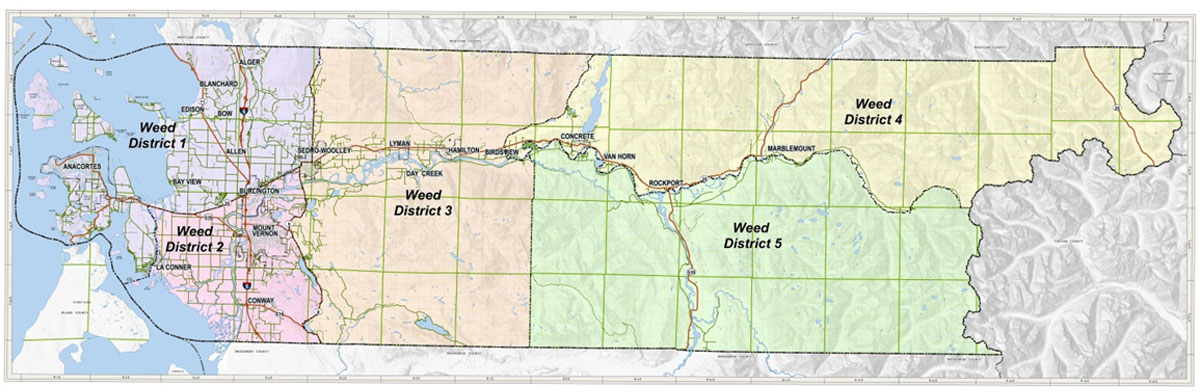
Skagit County is divided into five Noxious Weed Control Districts, each with a representative on the Skagit County Noxious Weed Control Board to provide input and guide program activities.

Learn more about the Noxious Weed Control Board's meetings, current members, and vacancies on our Boards and Committees page.

Beginning at the intersection of the North line of the Skagit County boundary and the centerline of State Route 9;Said intersection also being on the North line of Section 6, Township 36 North, Range 5 East, W.M.; Thence Southerly along the centerline of said State Route 9 to its intersection with the centerline of State Route 20;Thence Westerly along the centerline of said State Route 20 to its intersection with the medial line of the nautical fairway of Swinomish Channel; Said nautical fairway being delineated on NOAA Nautical Chart Number 18427, Anacortes to Skagit Bay, 24th Ed., May 2013;Thence Southerly and Southwesterly along said medial line and the Southwesterly extension thereof, to its intersection with the Southwestern boundary of Skagit County; Thence Northwesterly, Northerly and Easterly along the Skagit County boundary to the point of beginning.

Beginning at the intersection of the centerline of State Route 9 with the centerline of State Route 20;Said intersection being located in the Southwest ¼ of Section 24, Township 35 North, Range 4 East, W.M.; Thence Westerly along the centerline of said State Route 20 to its intersection with the medial line of the nautical fairway of Swinomish Channel; Said nautical fairway being delineated on NOAA Nautical Chart Number 18427, Anacortes to Skagit Bay, 24th Ed., May 2013;Thence Southerly and Southwesterly along said medial line and the Southwesterly extension thereof, to its intersection with the Southwestern boundary of Skagit County; Thence Southeasterly and Easterly along the Skagit County boundary to its intersection with the centerline of State Route 9;Said intersection also being on the South line of Section 32, Township 33 North, Range 5 East, W.M.; Thence Northerly along said centerline of State Route 9 to the point of beginning.

Beginning at the intersection of the Northern boundary of Skagit County and the centerline of State Route 9;Said intersection also being on the North line of Section 6, Township 36 North, Range 5 East, W.M.; Thence Southerly along the centerline of said State Route 9 to its intersection with the centerline of State Route 20;Thence Westerly along the centerline of said State Route 20 to its intersection with the centerline of State Route 9;Said intersection being located in the Southwest ¼ of Section 24, Township 35 North, Range 4 East, W.M.; Thence Southerly along the centerline of State Route 9 to its intersection with the Southern boundary of Skagit County; Said intersection also being on the South line of Section 32, Township 33 North, Range 5 East, W.M.; Thence Easterly along the Southern boundary of Skagit County to its intersection with the East Range line of Range 7 East, W.M.; Said intersection also being the Southeast corner of Section 36, Township 33 North, Range 7 East, W.M.; Thence Northerly along said East Range line to its intersection with the medial line of Finney Creek; Thence Northwesterly along the medial line of Finney Creek to its intersection, if extended, with the medial line of the Skagit River; Thence Southwesterly along the medial line of the Skagit River to the medial line of Grandy Creek, if extended; Thence Northerly along the extension of the medial line of Grandy Creek, and the medial line of Grandy Creek, to its intersection with the centerline of State Route 20;Thence Westerly along the centerline of State Route 20, to its intersection with the centerline of Baker Lake Road; Thence Northwesterly along the centerline of Baker Lake Road, to its intersection with the Northern boundary of Skagit County; Said intersection also being on the North line of Section 02, Township 36 North, Range 8 East, W.M.; Thence Westerly along the Northern boundary of Skagit County to the point of beginning.

Beginning at the intersection of the Northern boundary of Skagit County and the centerline of Baker Lake Road; Said intersection also being on the North line of Section 02, Township 36 North, Range 8 East, W.M.; Thence Easterly along the Northern boundary of Skagit County to its intersection with the Western boundary of Okanogan County; Thence Southerly along the Eastern boundary of Skagit County to its intersection with the Western boundary of Chelan County; Thence continuing Southwesterly along the Eastern boundary of Skagit County to its intersection with the South Township line of Township 35 North, W.M.; Thence West along the said South Township line to its intersection with the medial line of the North Fork Cascade River; Said intersection also being on the South line of Section 35, Township 35, Range 13 East, W.M.; Thence Northwesterly and Southwesterly along the said medial line of the North Fork Cascade River and its extension, to its intersection with the medial line of the Cascade River; Thence Northwesterly along the said medial line of the Cascade River and its extension, to its intersection with the medial line of the Skagit River; Thence Westerly along the medial line of the Skagit River, to the medial line of Grandy Creek, if extended; Thence Northerly along the extension of the medial line of Grandy Creek, and the medial line of Grandy Creek, to its intersection with the centerline of State Route 20;Thence Westerly along the centerline of State Route 20, to its intersection with the centerline of Baker Lake Road; Thence Northwesterly along the centerline of Baker Lake Road, to the point of beginning.

Beginning at the Southeast corner of Township 33, Range 7 East, W.M.; Said Southwest corner also being on the Southern boundary of Skagit County; Thence Easterly along the Southern boundary of Skagit County, to its intersection with the Western boundary of Chelan County; Thence Northerly along the Eastern boundary of Skagit County to its intersection with the South Township line of Township 35 North, W.M.; Thence West along the said South Township line to its intersection with the medial line of the North Fork Cascade River; Said intersection also being on the South line of Section 35, Township 35, Range 13 East, W.M.; Thence Northwesterly and Southwesterly along the said medial line of the North Fork Cascade River and its extension, to its intersection with the medial line of the Cascade River; Thence Northwesterly along the said medial line of the Cascade River and its extension, to its intersection with the medial line of the Skagit River; Thence Westerly along the medial line of the Skagit River, to the medial line of Finney Creek, if extended; Thence Southeasterly along the extension of the medial line of Finney Creek, and the medial line of Finney Creek, to its intersection with the East Range line of Range 7 East, W.M.;
Thence Southerly along said East Range line to the point of beginning.

Meeting Minutes and Agendas

1/15  Agenda | Minutes

1/28  Agenda | Minutes

4/16 Agenda | Minutes

7/17  Agenda | Delayed

1/16  Agenda | Minutes

4/17  Agenda | Minutes

7/17  Agenda | Minutes

11/20  Agenda | Minutes


1/18  Agenda | Minutes

4/18  Agenda | Minutes

7/18  Agenda | Minutes

11/21  Agenda | Minutes

Noxious Weed Laws

In recognition of the economic and ecological threats caused by invasive, non-native plant, there are both County and State laws in place to support noxious weed control.

Skagit County Code:

State Laws:

Summer Hours (as of May 1st)

Monday – Thursday (6:30am- 500pm)

Winter Hours

Monday – Friday (7:30am- 4:30pm)

Contact Us

Noxious Weeds Program

Evan Emrick
Noxious Weed Coordinator
(360) 707-1502
evane@skagitcountywa.gov

General Questions

Jenn E. Johnson
Natural Resources Division Manager
jennej@skagitcountywa.gov 

Address

1800 Continental Place
Mount Vernon, WA 98273