Farmland Legacy Program

Public Works | Natural Resources Division

A waterway winding through a patchwork of Skagit County Farmland, some of which is protected by Skagit County Farmland Legacy Program.
In the foreground is part of the 173 acres of prime farmland protected from development in 2021, along with 70 acres protected in 2023. Photo credit SP Fask.

Protecting today’s farmland for tomorrow.

The Farmland Legacy Program is a County-funded initiative that compensates landowners for placing a perpetual conservation easement on their land. Landowners retain ownership of their land and continue their farming operations as usual.

The program’s primary goal is to protect Skagit County’s vital agricultural productivity and character. Protecting Skagit County farmland sustains a future for our farmers.

View map of protected properties (pdf).

Are you a farmland owner figuring out next steps for your property? Visit our Land Transfer and Farmland Succession page!

Frequently Asked Questions

The Skagit County Farmland Legacy Program is a County initiative that protects farmland for being developed for other use. The County buys the development rights to agricultural land and places it under perpetual conservation easements. These easements make sure that the land stays farmland. Simply put, the Skagit County Farmland Legacy Program's mission is to keep farmers farming!

Every time farmland is developed, impervious surface and draining issues increase, and farming becomes more challenging. Driving large farm equipment down roads to other locations, for example, becomes difficult with increased traffic from homes and commercial development. Farmers experience these challenges up close. 

Farmland Legacy farmers and farmland owners are the program’s best advocates.

Conservation easements are bought using local Conservation Futures tax levy funds and may be leveraged with additional federal, state, or nonprofit funds.

If you own agricultural zoned land (Ag-NRL), then yes, you are eligible to apply.

Typically, the most value from protecting your farmland comes from having a development right—the right for a landowner to build a house on the property. Farmland must be at least 40 acres to have a development right or have been lot certified prior to May 5, 2005.

The Lot Certification process, completed with the Skagit County Planning and Development Services, determines the amount of development rights available to the landowner.

You’ll ensure that your land will only ever be used for farming and that Skagit County stays rural. You’ll help support local food production, preserve open space, keep development out of the floodplain, reduce urban sprawl and conserve prime agricultural soil for future generations.

You'll also receive a cash payout for voluntarily protecting your farmland!

Nothing changes in your ownership of the land and your management of the land.

Easement restrictions support the land’s use for agriculture. New building must be agriculture-related and not cover more than 2% of the total acreage (5% of the total for dairies and infrastructure-heavy farm operations)—which amounts to nearly an acre on a 40-acre farm property that can be developed for ag-related use.

It’s easy! Fill out the Farmland Legacy application (pdf). There is no cost to apply.

If you have questions, talk or email with Farmland Legacy Coordinator Sarah Stoner. Sarah is here to guide you through the process, which is unique to your circumstance and farmland.

Call (360) 416-1417 to request a paper application or arrange a meeting.

After applying, you’ll meet with Sarah Stoner, the Farmland Legacy coordinator, to discuss your property. The Sarah will work with you on an individual basis to address any issues with your application. 

Next, your application is reviewed and scored by the Conservation Futures Advisory Board. Site review criteria includes soil quality, parcel size, economic productivity, proximity to urban development and major highways, scenic and ecological considerations, and urgency of conversion risk.

If your property is selected, the value of your development right is determined by an appraisal of the land with the development right(s) intact and without them. Program staff apply to various appropriate funding partners in an effort to leverage local funds to the greatest extent possible.

Finally, Skagit County, funding partners, and the landowner review a draft of the conservation easement. You can see our base template easement (pdf) here. Once easement if complete, Skagit County places funds in escrow and those funds are disbursed to you once the easement is recorded with the Auditor's Office.

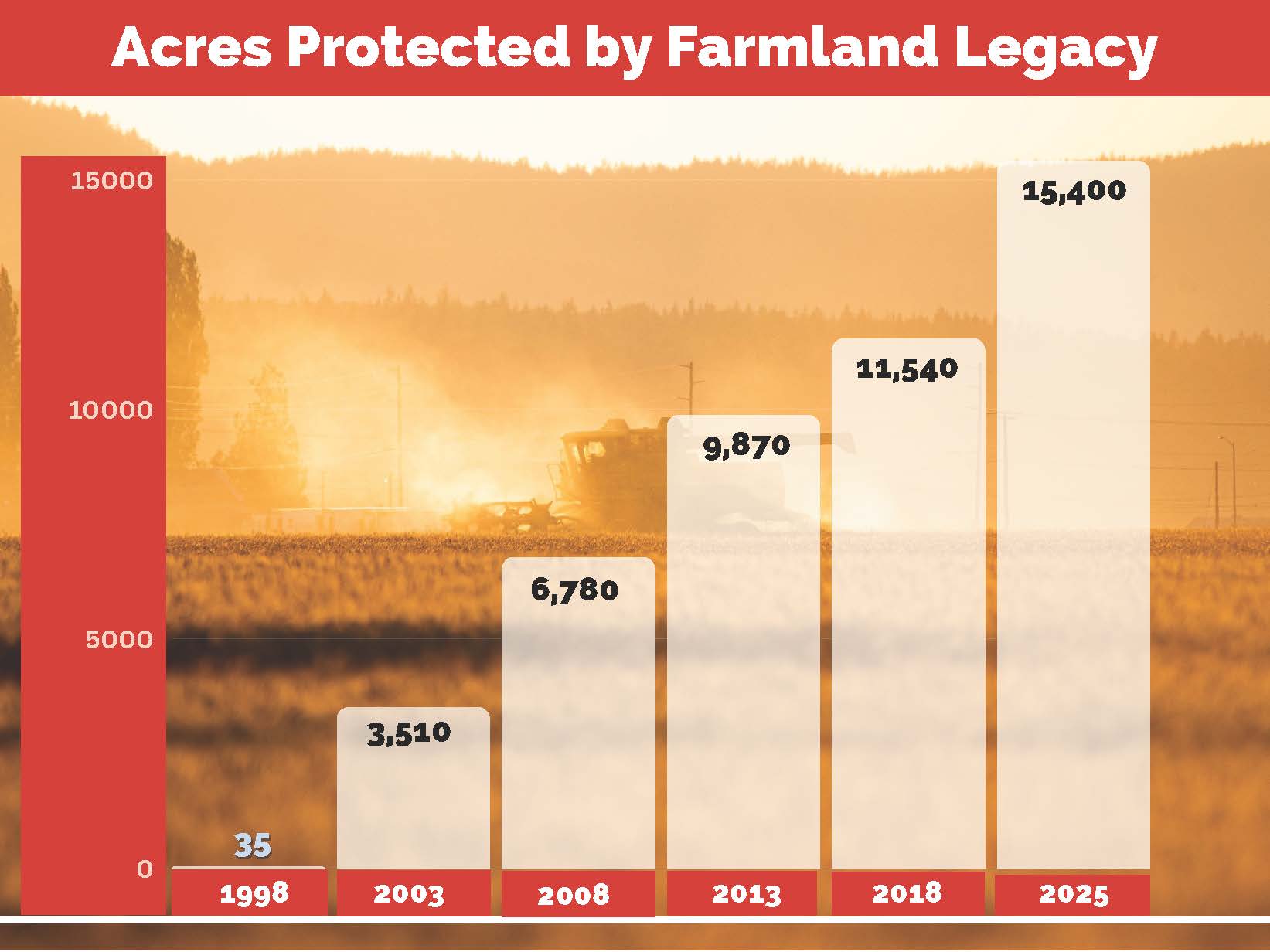
To-date, the Skagit County Farmland Legacy Program has protected more than 14,000 acres under conservation easement, enrolling more than 150 farmers in the program since its inception. Farmland owners often return to protect additional farmland through the program.


View a map of protected farmland in Skagit County (pdf).

Farmland Legacy Program Timeline

1997: The Farmland Legacy Program is established by the Skagit County Board of Commissioners, enabling use of the Conservation Futures taxing mechanism authorized by the state Legislature for easement purchase.

2009: Farmland Legacy receives state RCO grant award to protect Smith Farm, rated the top project in the state; and partners with the Nature Conservancy for the first time and Skagitonians to Preserve Farmland for the second time.

2022: The program celebrates 25 years of success as one of the most active and successful farmland preservation programs across Washington state, due to the number of protected acres and the ongoing community and county government involvement. Nearly 20% of land zoned Agriculture-Natural Resource Land (Ag-NRL) is protected from non-agricultural use through Farmland Legacy conservation easements.

Farmland Legacy Annual Reports

Conservation Future Advisory Board

The Skagit County Conservation Futures Advisory Board (CFAB) is responsible for administering the Farmland Legacy Program. CFAB reviews and recommends the proposed farmland to County Commissioners.

Member and meeting information

Click to view minutes and agendas (PDFs).

Agendas
Minutes

Agendas
Minutes

Agendas Minutes
1/13 1/13
2/10 Cancelled
3/10 3/10
4/14 4/14
5/12 5/12
6/9 6/9
7/14 7/14
8/11 Cancelled
9/8 Cancelled
10/13 Cancelled
11/10 11/10
12/8 12/8

Agendas Minutes
1/14 1/14
2/11 2/11
3/11 3/11
4/8 4/8
5/13 5/13
6/10 6/10
7/8 Cancelled
8/12 Cancelled
9/9 9/9
10/14 10/14
11/18 11/18
12/9 12/9

Agendas Minutes
1/9 1/9
2/13 2/13
3/12 3/12
4/9 4/9
5/14 5/14
6/11 6/11
7/9 7/9
8/13 Cancelled
9/10 9/10
10/5 Cancelled
11/12 11/12
12/10 12/10

Agendas Minutes
1/10 1/10
2/14 2/14
3/14 3/14
4/11 4/11
5/9 5/9
6/13 6/13
7/11 7/11
8/8 Cancelled
9/12 9/12
10/10 Cancelled
11/14 11/14
12/12 12/12

Agendas Minutes
1/11 1/11
2/8 2/8
3/8 3/8
4/12 4/12
5/10 Cancelled
6/14 6/14
7/12 7/12
8/9 8/9
9/13 9/13
10/11 Cancelled
11/8 11/8
12/13 Cancelled

Agendas Minutes
1/12 1/12
2/9 2/9
3/9 Cancelled
4/13 4/13
5/11 5/11
6/8 6/8
7/13 7/13
8/10 Cancelled
9/14 9/14
10/12 10/12
11/9 11/9
12/14 12/14

Banner image by Todd Johnson.

Contact Us

Sarah Stoner
Farmland Legacy Program Coordinator
(360) 416-1417 
sstoner@skagitcountywa.gov

Address

1800 Continental Place
Mount Vernon, WA 98273