Fish Passage Improvement
Public Works | Natural Resources Division
Find projects that benefit fish on the Restoration Projects page and the Current Road Construction Projects page.
Salmon in Skagit County
Skagit County waterways are home to all five species of Pacific salmon as well as steelhead, bull trout, lamprey, and many other fish.
Puget Sound Chinook salmon and Puget Sound bull and steelhead trout are listed as threatened under the Endangered Species Act due to their decline throughout the Puget Sound Region. Skagit County, along with many partner agencies, is committed to protecting these species, which are critical to local culture, ecosystems, and economy.
Barriers to Salmon
One of the most significant barriers to restoring salmonid populations is blocked access to habitat upstream. Many waterways pass through culverts— pipes that allow streams to flow under roads. These culverts are often damaged, undersized, or installed in a way that fish cannot access habitat upstream. In some cases, these culverts can block miles of important rearing or spawning habitat.
Skagit County acknowledges the role our infrastructure can play in blocking access to habitat. The County has been actively working to replace barrier culverts since the early 1990s. In doing so, the County is not only able to contribute to salmon recovery, but also to update aging infrastructure. These infrastructure updates often provide multiple benefits, including traffic improvements, flooding reduction, and more.
In 2014, the County attempted to prioritize culverts and brought nine to conceptual level design. Due to funding constraints in available grant programs, only one has been fully constructed since that time. Beginning in 2016, Skagit County partnered with Skagit River Systems Cooperative (SRSC), Upper Skagit Indian Tribe (USIT), and Skagit Fisheries Enhancement Group (SFEG) to assess culverts for fish passability according to Washington Department of Fish and Wildlife’s (WDFW) Barrier Assessment Methods to create a targeted approach for replacement over time.
Identification and Optimization Process
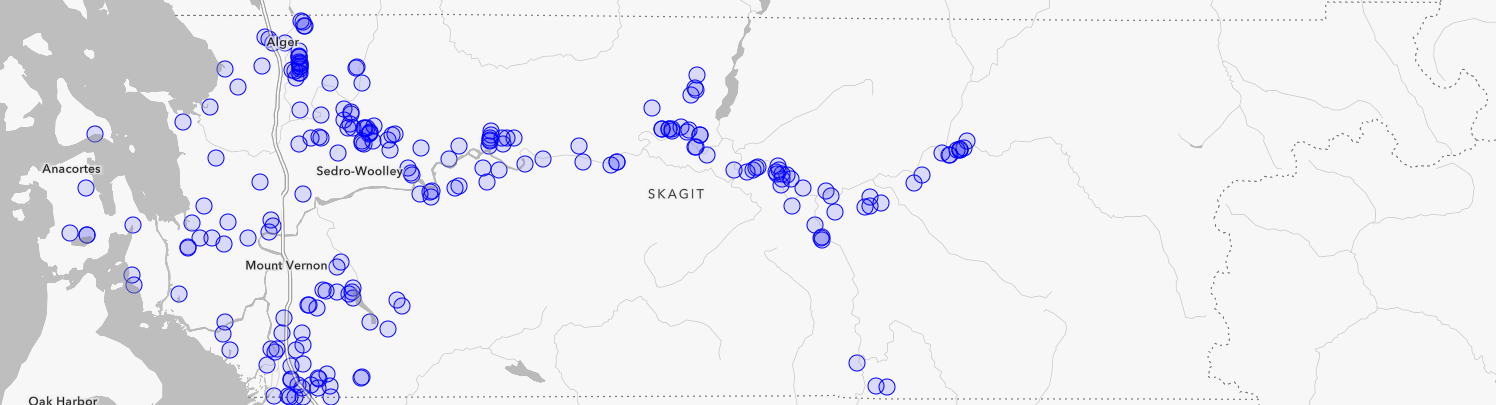
As a group, we assessed over 1,000 culverts to determine barrier status. In June 2020, SRSC published a report detailing findings from the assessment work completed by USIT, SFEG, and the County. The full report can be found online here (pdf). This report made no effort to prioritize culvert replacement as each organization has their own charge, but it did provide an up-to-date list of known barriers, why they are barriers, how much habitat they block, the current condition of the culvert, and other features helpful in determining a replacement order. There were some limitations to the completion of this report. Most notably, the report did not include the Samish watershed, the Skagit estuary, Fidalgo Island and upstream of the Gorge Dam at Newhalem due to some complicating factors in those areas. Work is ongoing to evaluate culverts in those sectors and the report will be updated over time with this information and updated culvert assessments within the original geographic area.
This group identified 107 barrier culverts and 15 culverts with unknown barrier status that are directly under ownership of Skagit County. There are numerous ways improvement of these culverts could be prioritized, and significant time could be spent trying to reach consensus among all our partners and stakeholders. With the immediate and critical situation involving our regional salmon stocks and the endangered Puget Sound Orca population, Skagit County plans to move forward and begin making positive progress. Skagit County has chosen to select culverts that have no known barriers downstream. When determining which culverts to prioritize from here, important factors included are percent passability, available habitat upstream, species use, culvert condition, and road maintenance needs.
Design
Skagit County quickly became aware that working through the standard grant process would take an unacceptable amount of time to complete restoration of our key culverts. The County reached out to the legislature to request $1 million to fund design of key culverts within the County. The County provided matching dollars to complete a total of 11 culvert designs by December 2025. The intent is that these designs will be more competitive for construction grant funding, allowing replacement on a much shorter timeline.
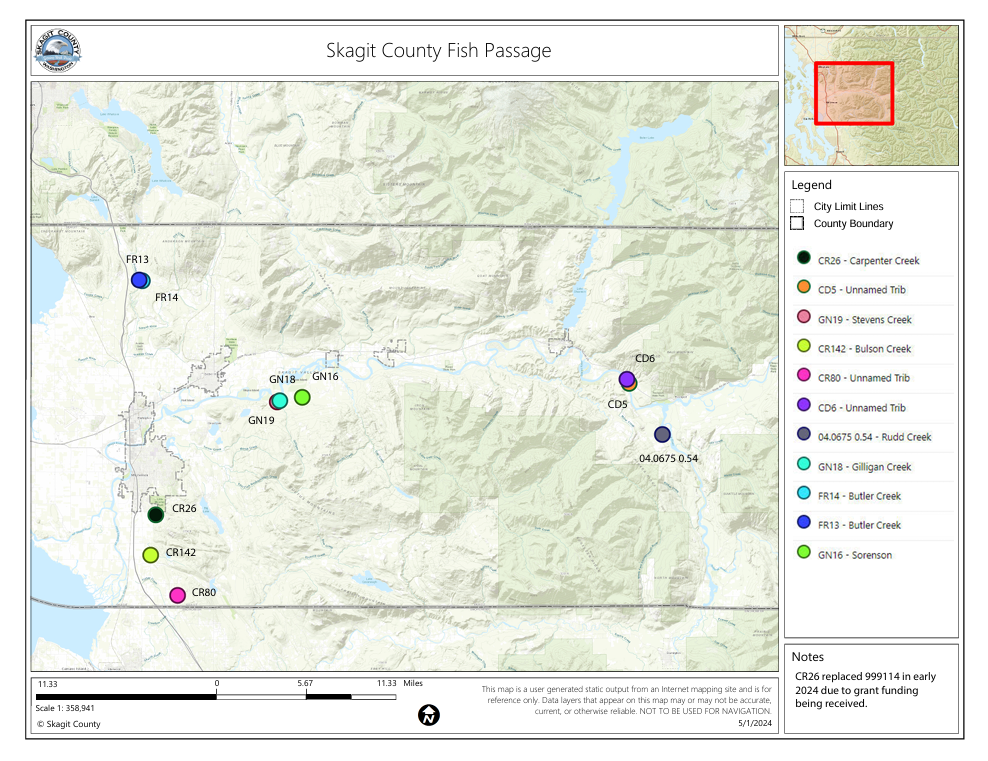
The County has been awarded funding from the state legislature on two occasions, once in July 1, 2022 and again on October 3, 2023. We have identified eleven culverts, two within the Samish watershed and the remainder within the Skagit watershed (see map and table below). Design work is underway.
| County Priority | Site ID | Road | MP | Stream | Latitude | Longitude | Most Recent Survey | Barrier Reason | Passability | Priority Index (PI) |
|---|---|---|---|---|---|---|---|---|---|---|
| 1 | GN16 | South Skagit Highway | 6.98 | Sorenson Creek | 48.48858 | -122.105 | 3/17/2016 | Drop and Slope | 0% | 31.13 |
| 2 | FR13 | Friday Creek Rd | 1.694 | Butler Creek | 48.59561 | -122.328 | 4/26/2022 | Slope | 33% | 34.23 |
| 3 | FR14 | Old Hwy 99 | 7.919 | Butler Creek | 48.59445 | -122.324 | 1/27/2009 | Slope | 33% | 30.43 |
| 4 | GN18 | South Skagit Highway | 5.52 | Gilligan Creek | 48.48553 | -122.136 | 3/20/2019 | Slope | 33% | |
| 5 | 04.0675 0.54 | Concrete-Sauk Valley Road | 12.2 | Rudd Creek | 48.45483 | -121.61 | 1/30/2018 | Drop | 33% | |
| 6 | GN19 | South Skagit Highway | 5.34 | Stevens Creek | 48.48426 | -122.139 | 1/9/2017 | Slope | 33% | |
| 7 | CR142 | Bulson Road | 4.11 | Bulson Creek | 48.34488 | -122.313 | 6/7/2018 | Slope | 33% | |
| 8 | CD6 | Sauk Store Rd | 0.6 | Unnamed | 48.50488 | -121.659 | 2/2/2011 | Drop | 0% | 10.83 |
| 9 | CR80 | Starbird Rd | 1.69 | Unnamed | 48.30813 | -122.276 | 4/19/2016 | Drop | 0% | 8.84 |
| 10 | CD5 | Sauk City Road | 0.1 | Unnamed | 48.50122 | -121.656 | 12/9/2010 | Drop | 0% | |
| 11 | CR26 | Cascade Ridge Drive | 0.053 | Carpenter Creek | 48.38158 | -122.306 | 3/3/2020 | Slope | 67% | 50.84 |
PI - The Priority Index (PI) is a number calculated by the Washington State Department of Fish and Wildlife (WDFW) for each culvert using a modified version of its formula. The PI equation uses six modifiers for each fish species within the stream reach of interest. The WDFW uses PI values to prioritize county road crossings for future fish passage barrier correction. The higher the number the larger the benefit. PI requires physically walking each stream to its headwaters. This work is ongoing.
What else do we do for salmon?
Skagit County is committed to protecting salmon through more than just culvert removal. Here are some more ways that we are trying to improve salmon habitat and population numbers:
- In partnership with Skagit Tribes and resource agencies, we are working hard to hold the City of Seattle accountable to install fish passage at its Skagit River hydroelectric dams, seeking to replicate the proven success that fish passage has created at most other dams in the Pacific Northwest.
- We are working with Skagit Tribes and resource agencies to coordinate major high-priority estuary restoration projects that will also improve infrastructure resilience and public safety.
- We’re working to protect and improve water quality standards for the Samish and Skagit system through our Clean Water Program, in cooperation with the State Department of Ecology.
- Our Voluntary Stewardship Program (VSP) helps acquire and plant riparian buffers along salmon-bearing streams that run through Skagit County farmland
Find projects that benefit fish on the Restoration Projects page and the Current Road Construction Projects page.
More Information
- WDFW Fish Passage Inventory, Assessment, and Prioritization Manual (pdf)
- High Priority Culverts 2014 (pdf)
- Skagit Basin Barrier Culvert Analysis: Public and Private Stream Crossings (pdf)
- Skagit Fisheries Enhancement Group culvert resources for private landowners
- Skagit Staff meets with Rick Larson to highlight culverts
- Washington Department of Fish and Wildlife Culvert Database


